 Phone: (021) 073-9955
 Location: New Zealand



Do Google Reviews Matter for Fence Companies? (And How to Get More of Them)
Yes. Google reviews directly affect whether your fence company shows up in the local map pack, and they're often the only proof a homeowner has that you'll actually show up and do the job right. More reviews, especially recent ones, mean more calls. Fewer reviews mean you're invisible next to the three competitors who asked.
Key Takeaways
- Google's local pack weighs review count, star rating, and how recent your reviews are, so an active review base outranks a stronger fence company with a stale one.
- A new fence runs most homeowners $2,000 to $10,000 and can't be judged by watching you work for ten minutes, so reviews do the job a neighbor's referral normally would.
- Recency is close to non-negotiable: in BrightLocal's surveys, 73% of consumers once said reviews had to be from the last month, and in 2026, 74% still won't look past the last three months.
- The highest-converting moment to ask is the final walkthrough, in person, with a QR code that opens your Google review page in one tap.
- Buying reviews breaks the FTC's 2024 fake-review rule and Google's policies. Asking every customer the same way, with no incentive attached, is the only safe method.
I had a partner tell me he didn't see the point. "People don't leave reviews," he said. "I never do." Fair point, and most people don't, on their own. So I asked him one question: if three new reviews on your Google Business Profile brought in one or two more jobs, would that be worth sending a text message to a handful of people? He said obviously yes. I told him to send me a short list of customers he was confident would say something nice, and we set up a simple review request for each of them.
Fifteen new reviews in nine days. He was surprised people were willing to post on his Google Business Profile. Now he asks after every single job without being reminded.
That's really the whole article in miniature. Reviews aren't hard to get. They're just easy to skip.
Why Google Reviews Matter for Fence Companies
Two things are happening at once when someone searches "fence company near me," and most fence contractors only think about one of them.
The first is ranking. Google's local pack, the map and three business listings that show up above the regular search results, weighs review count, review recency, and star rating heavily. Not exclusively. Google's own local ranking guidance lists relevance, distance, and prominence as the three inputs, and reviews feed prominence. Your Business Profile category, proximity to the searcher, and the rest of your fence company SEO all factor in too. But reviews weigh heavily enough that a company with 40 recent reviews at 4.8 stars will consistently out-rank a company with 12 reviews from three years ago, even if the older company does better work.
The second is trust, and this one matters more for fencing than it does for a lot of other trades. A new fence runs most homeowners $2,000 to $10,000, and more for longer runs or premium materials like cedar or wrought iron. That's not an impulse buy. And unlike a plumber fixing a leak, a homeowner can't watch you work for twenty minutes and get a feel for whether you know what you're doing. They're hiring you based on a phone call, a quote, and whatever they can find online. Reviews are doing the job a referral from a neighbor would normally do, except most people don't happen to know a neighbor who just had a fence built.
A third factor is specific to your trade: fences are visual. A finished fence photographs well, and photo reviews (the kind where a customer uploads a picture of the actual completed job) carry more weight with readers than plain text like "great service, highly recommend," because they're proof, not just an opinion. Most fence companies never ask for the photo. That's a miss, and it's an easy one to fix once you start asking for reviews on purpose instead of hoping they happen.
Get Proven Text Messages That Generate Reviews
Want our ready-to-send text messages? We’ve put together a free guide explaining how to get Google reviews for your fence company. It includes the three messages our partners use to get more reviews, plus the script your crew can use during the final walkthrough. Copy them straight to your phone and start asking today.
Download NowWhen to Ask (Timing Is Everything)
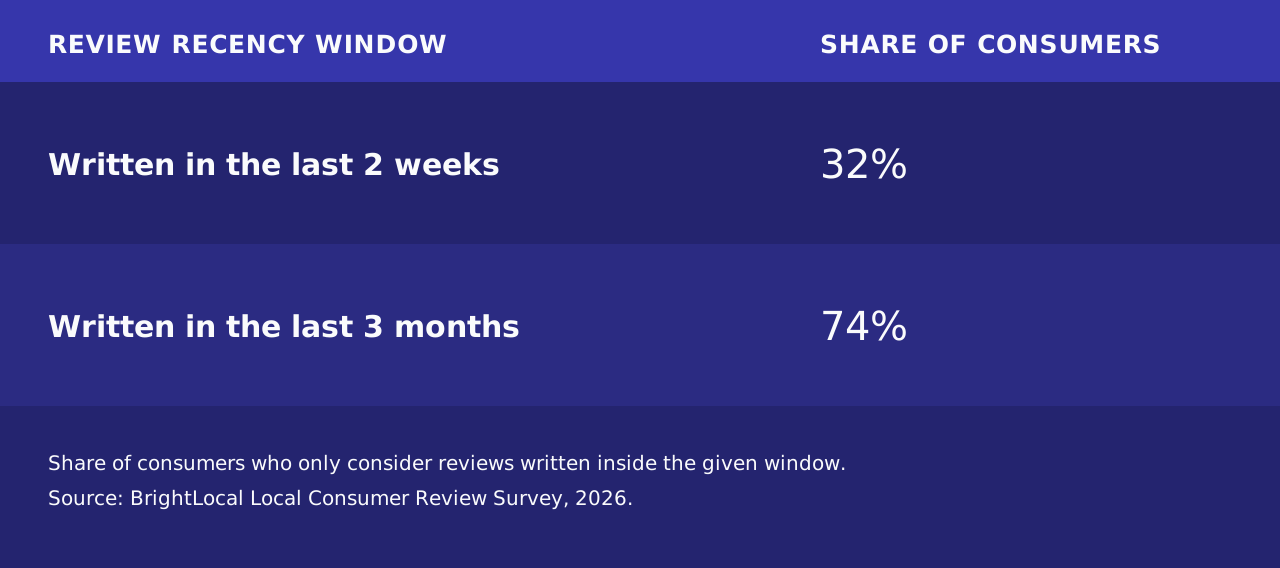
Here's a stat worth knowing. BrightLocal's Local Consumer Review Survey has tracked review recency for years, and the message has stayed consistent. In its 2020 survey, 73% of consumers said a review had to be from the last month to factor into their choice of a local business. Expectations have loosened a little since then, but not much: the 2026 survey still puts 74% of people inside a three-month window and 32% inside the last two weeks. Not "reviews from a reputable company." Recent reviews. Volume matters less than most contractors think, which means a fence company that stopped asking two years ago is close to invisible to the people reading its profile today, no matter how good that old work was.
Which brings up the actual best moment to ask, and it's one most trades don't have. So, what is it? The final walkthrough.
You've just finished the fence. The customer is standing in their yard looking at it, often for the first time as a complete, finished thing, since most of the build happened while they were at work. The posts are set, the gate swings clean, the yard's been cleaned up. They're proud of it. That's not a metaphor. People genuinely feel a small rush of satisfaction looking at a finished fence line, especially if it replaced something falling apart. That emotional peak is the best five minutes you'll get with this customer, full stop, and it happens on-site, not three days later over email when the feeling has faded into "yeah, it's fine, I'll get to it."
Ask right there. Not "we'll send you a link later." Right there, while you're both standing in front of it.
How to Make Leaving a Review Frictionless
Asking is only half the job. If leaving a review takes more than about 20 seconds, most people will mean to do it and then forget by the time they're back inside.
A Direct Google Review Link
Every Google Business Profile has a "get more reviews" feature in the dashboard that generates a short URL, something like g.page/r/your-business/review, that drops a customer straight into the review box with no searching for your business name required. Generate this once and reuse it everywhere: text messages, email signatures, invoices.
A QR Code That Points to That Same Link
This is the part almost nobody in fencing does, and it's the easiest win in this whole article.
Putting It on Job-Site Signage
Most fence companies already put a yard sign in front of finished jobs, a smart move since it's free advertising to the whole street. Put a QR code on that sign. Put one on your business cards. Put one on the invoice you hand over at the walkthrough. Neighbors who walk by and admire the new fence can scan it on the spot, and the homeowner can scan it standing right there with you before you've even packed up the truck.
None of this requires new software or a review-management platform. It's a code generated from a link, printed on something you're already using.
Scripts and Templates for Asking
The install crew and the office staff need different scripts, because they're catching the customer at different moments with a different level of rapport already built.
What the Install Crew Says at the Walkthrough
Keep it short. You're standing there with them, so this isn't a pitch, it's a favor between two people who just spent the day (or the week) working together.
"Hey, we're really glad this turned out the way you wanted. If you've got 30 seconds, would you mind leaving us a quick Google review? Here's a QR code, it goes straight to the review page. Even a couple lines about your experience helps us out a lot."
What Office Staff Sends by Text or Email
This is the backup for anyone who didn't scan on-site, or for jobs where the crew lead forgot to ask. It happens. Build the follow-up in so it isn't optional.
"Hi [Name], thanks again for choosing [Company] for your fence project! We'd really appreciate it if you could share a quick review of your experience. Here's the direct link: [link]. It only takes a minute and it means a lot to a small local business like ours."
Send that text within 24 hours of the walkthrough, not a week later. This is the same recency principle from the stat above. Waiting kills momentum.
Responding to Negative Reviews (Including Fence-Specific Disputes)
You will get a bad review eventually. Every company that does enough volume does. What matters is the response, because prospective customers read your responses at least as closely as they read the review itself. A calm, professional reply to a harsh review often builds more trust than a page of five-star reviews with no responses at all.
General rule: respond within 24 to 48 hours, acknowledge the specific complaint rather than a generic "sorry you feel that way," and move the actual resolution offline. Leave your response as the public record of how you handle problems, since that's really who it's written for.
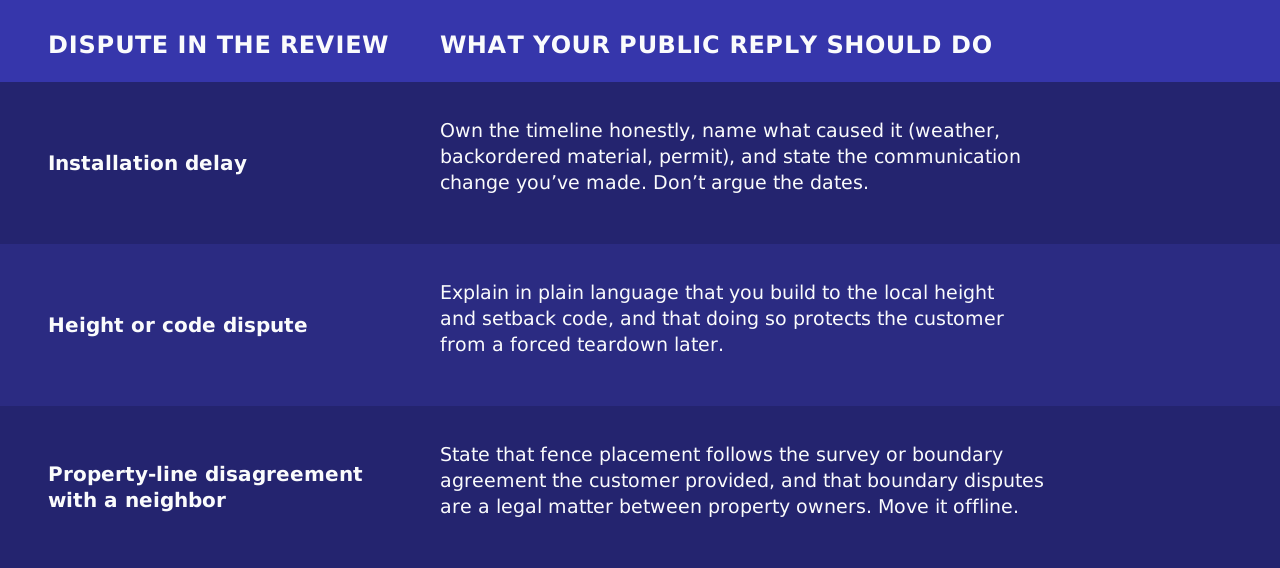
Fencing has a few disputes that show up often enough to plan for specifically. The table is the quick version of how to answer each one in public. The detail follows below it.
Installation Delays
Weather, material backorders, and permit holdups push fence jobs later than quoted more often than almost any other trade. If a customer's frustrated review is about a delay, own the timeline honestly in your response and note what you did to communicate along the way. If communication genuinely fell short, say you're changing that process. Customers reading it will notice the honesty more than they'll hold the original delay against you.
Height or Code Disputes
Sometimes a customer wants a 7-foot privacy fence and the city caps residential fences at 6 feet, or a specific setback applies near a corner lot. If a review complains that you "wouldn't build what I asked for," your response should calmly state that you build to local code requirements, which protect the customer from a forced teardown later. This is a case where being right isn't enough. You have to actually explain why in the reply, in plain language, because the person reading it isn't a code inspector.
Property-Line Disagreements With Neighbors
This one usually isn't about your work at all. It's a dispute between the homeowner and their neighbor over where the line actually sits, and you got dragged into the review because you're the visible party who built something. Note in your response, briefly and professionally, that fence placement follows the property survey or boundary agreement the customer provided, and that boundary disputes are a legal matter between property owners. Don't get pulled into litigating it in the review thread.
Is It Legal to Ask For, or Buy, Google Reviews?
This is something I have to comment on because it's often a question that comes up. It's the one thing every fence-marketing article skips, and it's exactly what people are searching for when they're deciding whether to cut a corner.
None of this is legal advice. Talk to an attorney for anything specific to your situation. But here's the honest answer.
Is It Legal to Buy Google Reviews?
No. In 2024 the FTC finalized a rule specifically banning the sale and purchase of fake reviews and testimonials, with real financial penalties attached. Separately, Google's fake engagement policy prohibits reviews that were paid for, directly or in kind, on Business Profiles. Get caught, and Google can remove the reviews, suppress your listing's ranking, or suspend the profile outright. The upside of buying reviews, a quick bump in count, is temporary. The downside, an FTC violation plus losing your Business Profile, is not.
Can You Legally Ask for a 5-Star Review?
You can ask for a review. You cannot ask specifically for a 5-star review, and you cannot offer anything (a discount, a gift card, an entry into a drawing) in exchange for a positive one. That crosses into the same incentivized-review territory the FTC rule targets. Ask everyone the same way, ask for their honest experience, and let the star rating fall where it falls. If your work is good, it mostly falls at five stars anyway.
Can Google Detect Fake Reviews?
Increasingly, yes. Google uses automated systems to flag suspicious patterns: a burst of five-star reviews arriving in the same hour, reviewer accounts with no other review history, reviews posted from IP addresses tied to the business itself. It also relies on user reports. None of this is airtight, but the trend is toward better detection, not worse, which is one more reason a slow, steady, genuinely-asked-for stream of reviews beats any shortcut.
Want To Work With Pax Pro?
You can run everything I've mentioned manually. A shared spreadsheet of customer names, a QR code you print at the office, a text sent from someone's phone. That's exactly how the fifteen-reviews-in-nine-days example above happened, with no software involved at all.
Once you're getting leads consistently, this is where Pax Pro comes in. We build review generation and reputation management into the local SEO service we run for fence companies, so the ask isn't something you have to remember to do. The day a job gets marked complete, a text goes out automatically. The system tracks who's been asked and who hasn't, and replies to reviews that have come in. It pairs naturally with a referral push, which we cover in how to get more fence referrals.
Download NowWant to Know More?
Book A Call
Frequently Asked Questions
-
Yes. Review count, average rating, and how recent your reviews are all factor into Google's local pack ranking, alongside your Business Profile details and proximity to the searcher. A fence company with a strong, current review base consistently outranks one with the same quality of work but a thin or outdated review history.
-
There's no fixed number. It's relative to what your local competitors have. If the top three results in your area average 30 to 50 reviews, that's your real benchmark, not some universal target pulled from a marketing blog. What matters more than hitting a specific count is keeping reviews coming in regularly, since recency carries as much weight as volume.
-
No. The FTC's 2024 rule against fake and paid reviews prohibits it outright, and Google's own policies ban incentivized or purchased reviews on Business Profiles. Violations can mean removed reviews, a suppressed listing, or a suspended profile.
-
Ask in person at the final walkthrough, while the customer is standing in front of the finished fence. That's the emotional high point of the whole project. Have a QR code ready that links straight to your Google review page, and follow up by text within 24 hours for anyone who didn't scan it on the spot.
-
Respond within 24 to 48 hours, address the specific complaint by name rather than a generic apology, and take the actual resolution offline. For disputes that aren't really about your workmanship, a property-line disagreement with a neighbor, for example, state plainly that fence placement follows the survey or boundary information the customer provided, and avoid arguing the dispute itself in the review thread.