 Phone: (021) 073-9955
 Location: New Zealand



The Fence Lead-Response System: From Form Submitted to Job Signed
Curtis founded Pax Pro, a marketing agency that works only with fence contractors. He builds the lead-response and follow-up systems that turn quote requests into signed jobs, and he writes about the sales side of running a profitable fence calendar.
Most fence companies don't lose the lead they never received. They lose the one that arrived, got a quote, and went quiet while nobody owned the next step. A fence sales process eliminates that gap by giving every lead a single path from the form submission to a signed contract, with a named owner and a defined next action at every stage. This guide summarizes the six stages of that path — speed to lead, follow-up cadence, quote structure, objection handling, CRM automation, and the review-and-referral loop — and points you toward the detailed guide for each one. It belongs inside our complete guide to marketing a fence business as the sales-system layer underneath everything else, and it reflects how we build these systems for fence contractors day to day.
Key Takeaways
- A fence sales process is one path every lead follows from form submitted to job signed, with a named owner and a next action at each stage. Jobs leak between stages, not inside them.
- Move fast on the first response and slow down after the quote. The research on fast response measured reaching and qualifying leads, not signed jobs, and none of it studied fencing.
- There is no proven number of follow-ups. Run a short, respectful cadence that ends in a clear answer, and skip the "80% of sales need five follow-ups" line — it has no credible source.
- Automate the timing, reminders, and record-keeping; keep the messages human. Marketing texts and emails have to meet FCC and FTC rules, which are operating guardrails, not legal advice.
- Measure three separate rates: response rate, quote recovery rate, and responder close rate. Reporting one as another oversells the result.
What a fence sales process actually is
A fence sales process is a written path every lead follows from first contact to a signed contract, with one person responsible and one next action at every step. It is the difference between "I'll call them when I get a chance" and a system that produces a known outcome for every quote you send: signed, revised, postponed, declined, or closed.
Most shops don't have one. The pipeline runs off memory, a whiteboard, and whoever picks up the phone. That works until a busy month buries the follow-up. Then the calendar goes quiet a few weeks later, for no reason anyone can point to.
In the pipelines we audit, the stage that leaks most often is not speed to lead. It is the gap between a sent quote and a scheduled follow-up, because that is the one step nobody owns by default. Writing the process down is what makes that gap somebody's job.
The six stages
The path has six stages, and the handoffs between them are where jobs go missing:
- Speed to lead — how fast you answer a brand-new inquiry.
- Follow-up cadence — what you send, and when, after the quote goes quiet.
- Quote structure — whether the estimate gives the customer enough to say yes.
- Objection handling — what you do with price, timing, and "we're still thinking about it."
- CRM automation — the timing, reminders, and records that keep nothing from being dropped.
- Review and referral loop — turning the finished fence into the next lead.
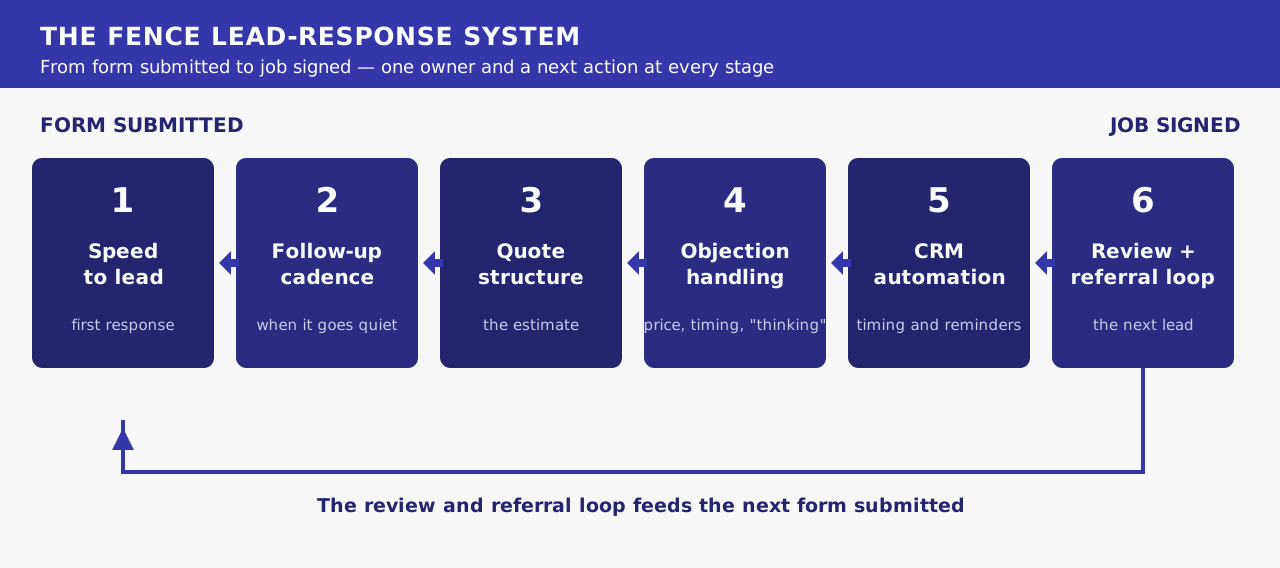
The stages connect in one direction, and each one depends on the quality of the previous. A fast first response earns you the right to submit a quote. A clear quote earns a genuine reply instead of silence. A useful reply surfaces an objection you can actually resolve. Reliable automation ensures none of that depends on someone remembering to do it on a Friday afternoon. Finally, a finished project handled well deposits a fresh lead back at the top. Skip a stage and the following one inherits the problem: a vague quote turns objection handling into guesswork, and a missing review step leaves speed to lead with fewer warm inquiries to answer.
A missing handoff is expensive in a specific way. The lead still cost you money: the ad click, the Local Services Ad charge, or the referral you earned by finishing someone else's fence. Then it stalls between "quote sent" and "decision made," where no one is watching. You do not feel it as a loss. You feel it as a slow month you cannot explain. Writing the process down makes those gaps visible while there is still time to close them.
Who this is for
Owner-operators running roughly $300K to $1.5M who work the pipeline themselves, and growth-stage companies between $1.5M and $6M with a salesperson or two and no shared standard. For a solo operator the whole system lives with one person, so the risk is time: the follow-up that does not happen because you were on a job site. For a bigger shop the risk is the handoff — the estimate the salesperson sent that the office never followed up on because each assumed the other had it. Same six stages, different failure points, and the fix in both cases is the same: one named owner and one next action per stage.
Stage 1: Speed to lead, your first response
Answer a new fence inquiry as fast as you realistically can during business hours. The contractor who gets into a real conversation first usually gets the first shot at the job.
In a 2011 Harvard Business Review audit of 2,241 U.S. companies, only 37% responded to a web lead within an hour and 23% never responded at all. The companies that made contact inside that first hour were about seven times more likely to have a qualifying conversation. Separately, the MIT Sloan and InsideSales.com Lead Response Management study looked at more than 15,000 leads across six companies. It found a business was roughly 21 times more likely to qualify a lead when it made contact at the five-minute mark instead of thirty minutes.
Both studies measured whether anyone reached and qualified the lead, not whether the job was signed, and neither looked at fencing. Take them as direction, not a promise. Here is a target you can actually hit: call back within five minutes during business hours, or text within about a minute if you can't pick up. Then follow up again the same day, and treat every missed call as a lost bid until you prove otherwise.
For a fence company, the practical difficulty is that the person best placed to answer is usually up a ladder. A homeowner submits three or four quote requests in a single Saturday sitting, and the first contractor into a genuine conversation sets the frame for every competing quote that follows. At the hub level this stage has one responsibility: ensure a new inquiry receives a human response the same day, every day, regardless of whether you are personally available to give it. Everything about which channel to use, which script to follow, and how to cover the gap while crews are working belongs to the dedicated guide.
The owner of this stage is whoever holds the phone during business hours, and the next action never changes: reply, log the inquiry, and schedule the follow-up. The full breakdown is in why the first fence contractor to respond wins, and the missed-call text-back setup has its own guide.
Stage 2: Follow-up cadence, what to send when it goes quiet
Silence after a quote is a status with a next action, not a no. Run a short, respectful sequence that ends in a clear answer.
Homeowners compare before they choose anyone. The Federal Trade Commission tells consumers to get multiple written estimates, so a few quiet days after you send a quote is normal shopping, not rejection.
Here is a cadence you can test. Confirm the quote arrived in the first day or two. Ask one diagnostic question around day five. Offer a legitimate revision, or a good, better, best option, around day ten to fourteen. Ask for a decision before the price genuinely expires. Then send one close-the-loop message and stop the active sequence. No credible study establishes a best number of touches for fence work, so treat that sequence as a starting point to measure against your own reply and close numbers, not a formula.
The difference that matters at this stage is between a nag and a diagnostic. "Just checking in" adds nothing and trains the customer to ignore you. By contrast, a diagnostic touch asks one specific question: is it the price, the timing, the material, or another decision-maker. It also gives them an easy way to answer, including "no." A sequence that never ends is how helpful follow-up turns into the pushy routine homeowners say drives them away.
New-lead silence and post-quote silence are different problems and need different messages. A brand-new inquiry that goes quiet is a speed-to-lead issue; a quote that goes quiet is a decision that has not been made yet. Quotes that went cold weeks or months ago are their own campaign, worked separately, and only when you have a compliant basis to reach out again.
In one Pax Pro client campaign, 39 dormant contacts replied and 20 of those people signed jobs — about $110,000 in booked revenue at the client's reported $5,500 average job value. That is one client's result, not an industry benchmark, and the 51% is the share of people who replied and then signed, not a recovery rate against every quote on the list. It is on this page as an example of what a written cadence can surface in a pipeline, not a number to expect.
The owner of this stage is whoever sent the quote, and the next action is the scheduled touch — not "when I think of it." The scripts, the exact timing, and the tracking sheet are in the spoke.
Fence estimate follow-up has the timing, the text and email scripts, the quote-expiry rules, and the tracking.
Download NowStage 3: Quote structure, the estimate that closes itself
A quote that spells out the scope, the assumptions, and a price-good-until date removes most of the reasons a customer stalls.
It should state fence type, height, rough footage, gate count and hardware, removal and disposal, finish, key assumptions and exclusions, who pulls permits and marks boundaries, timing, the payment schedule, and the date the price holds. Some of that sits on the customer's timeline too: contacting 811 before any digging is part of the job, and the estimate should say so.
A vague quote gets vague silence. If the customer cannot tell what is included, what is excluded, and how long the price holds, they cannot really say yes, and your follow-up ends up doing work the estimate should have done. It also helps to tell them which document they got: an estimate is a projection that can move, a quote is usually a fixed price for a set scope and window.
Clarity is rarer than you would think, and customers notice. In a survey of 1,040 U.S. homeowners fielded in October 2025 by Housecall Pro, 93% said instant, upfront estimates influence who they hire and 77% said hidden costs frustrate them. Options help too: in Jobber's December 2025 survey of 1,050 U.S. home-service business owners, fielded by Conjointly, only 16% offered tiered good, better, best pricing, so an options-based quote still stands out. Give the customer a choice between three real versions of the job rather than a single number to accept or reject, and change the scope or the materials before you cut your margin.
This stage owns the document, not the price math behind it. The takeoff, loaded labor, overhead allocation, and the formula that turns cost into a selling price are all in how to estimate a fence job, along with a free calculator.
Stage 4: Objection handling, price, timing, and "we're still thinking about it"
Find the real objection before you answer the stated one. Most "it's too expensive" is really "I can't line these three quotes up against each other."
Work the branch, not the price. If it is price, change the scope or offer material and gate options. If it is timing, give a real install window or agree on a month to circle back. If the quotes are hard to compare, line up footage, gates, removal, material grade, post depth, warranty, and permit assumptions so your quote and the competitor's describe the same job. If it is a property or HOA holdup, find the survey, boundary, neighbor, or permit decision that is actually stuck. If it is trust, send photos of finished jobs like theirs, your license and insurance details, and a real review or warranty.
Price pressure is often a budget problem, not a negotiating move. In that Housecall Pro survey, 55% of homeowners expected flexible payment plans or financing, and 70% said they would pay more for a company with a better service reputation. Answer price with terms or a scope change, and answer "thinking about it" with proof, not a reflex discount.
A quick example of working the branch. A homeowner says your $9,200 cedar quote is "a lot more than the other guy." Before you move on price, you ask what the other quote covers. It turns out theirs is pine, no old-fence removal, and two feet shorter on one run. Now the conversation is about which fence they actually want, not about your margin, and you can offer a cedar-to-pine option in writing if budget is the real limit. That is the move at this stage: convert a price objection into a scope decision the customer can make.
In Modernize's 2024 survey of nearly 3,000 homeowners, expertise, warranties, communication, reputation, and availability all shaped who got hired, and pushy sales tactics were the single most common thing that turned homeowners off. Keep every claim about price, availability, or deadlines accurate — FTC advertising guidance requires it — and skip invented shortages and false "last chance" lines. The dedicated objection-handling guide, with a response for each branch, is on the way.
Stage 5: CRM automation, make the system run without you
Automate the timing, the reminders, and the record-keeping. Keep the actual messages personal.
Automate lead assignment, response-time alerts, cadence reminders, stage tracking, and review requests. Keep a person on the diagnostic questions, the revision conversation, and the close. Missed-call text-back is one of the highest-impact pieces for a shop that runs crews all day, because the alternative is a voicemail nobody checks until dark.
Automate one thing first: the response-time alert and the missed-call text. The moment a lead comes in or a call is missed, the system pings the right person and sends the customer a short "we got your message, here is when we will call" text. Next, put the follow-up cadence on rails so each touch is scheduled the second a quote goes out. Leave the wording of the touches to a person. A templated "just checking in" reads like a templated "just checking in."
Automation is common in the trade now. In Jobber's December 2025 survey of 1,050 home-service owners, 52% said they already use AI in day-to-day operations and 54% use it for quoting. Jobber also reports that its top-performing users lean on quote templates and automated reminders. That is a correlation worth noting, not proof that automation closes jobs on its own. Whether you build this in the CRM you already run or add a tool is a budget-and-time question, and the missed-call text-back and web-chat comparisons are covered in their own guides.
It matters for paid traffic as well: running Google Ads for a fence company only pays back when the follow-up behind it works, because every click you buy still lands in this same system.
Automated marketing texts and emails come with rules. The FTC's CAN-SPAM compliance guide calls for accurate sender and subject information, a physical mailing address, and a working opt-out processed within ten business days, and you stay responsible even when a vendor sends for you. The FCC's 2024 consent-revocation order confirms a customer can withdraw consent by any reasonable method, so suppress the number the moment someone replies STOP. Ignore outdated advice about the FCC's one-to-one lead-generation consent rule; the Eleventh Circuit vacated it in January 2025. Treat all of this as an operating guardrail and have a lawyer review any automated campaign and your state's rules.
Stage 6: The review and referral loop, turn one job into the next
The signed contract is not the end of the process. The finished fence is the start of your next lead.
Ask for the review as a scripted step in the final walkthrough, not an afterthought email a week later. Put the referral ask in the same moment, while the customer is standing in front of a fence they like.
Referrals carry the trade. In Jobber's December 2025 survey, 59% of home-service owners said referrals and repeat work are their top source of leads. The willingness is there too: in the Housecall Pro survey, 73% of homeowners said they would refer a company after excellent service and 68% said they would hire it again. Still, those numbers show intent, not a conversion rate from any specific ask.
In practice, the mechanics are simple and they belong in the walkthrough. Walk the finished fence with the customer and confirm they are happy with the gate swing and the line. Then say you would appreciate a quick review, and hand them a card or a text link on the spot. Ask who else on their street has mentioned needing a fence. Do it then, in person, not in an email three days later when the moment has passed.
Reviews do the same job earlier, when a homeowner is weighing you against two other quotes. BrightLocal's Local Consumer Review Survey finds most people check more than one local business before deciding. Our guide to whether Google reviews matter for fence companies covers the ask itself. A referral-only pipeline has no floor under it, because it depends entirely on how many fences you happened to finish recently; a referral step built into every job gives it one.
Download NowHow to measure the whole system
Track three separate rates. Do not blend them, and do not report one as another.
- Response rate: replies divided by delivered messages. Tells you whether the message and channel are landing.
- Quote recovery rate: signed jobs divided by eligible dormant quotes. Tells you the real return on the whole effort.
- Responder close rate: signed jobs divided by the people who replied. Tells you how well you close once someone is talking.
A high responder close rate is not a recovery rate. If 20 of 39 repliers sign, that is a 51% responder close rate, and it says nothing about the hundred other quotes that never replied. Keep a simple scorecard: leads in, first-response time, quotes sent, replies, reopened opportunities, revised quotes, signed jobs, booked revenue, and any opt-outs or complaints.
Run it for a month and the numbers point at the weak stage. For example, say you send 40 quotes, 12 people reply, and 6 sign. A 50% responder close rate means you close well once someone is talking, so the problem is upstream: the quote or the cadence is not earning replies. Flip it to 25 replies and 4 signed, and the follow-up is fine but the close or the quote structure needs work. Either way, one month of honest tracking tells you which of the six stages to fix first. That beats a general sense that "sales could be better."
Your 30-day build
You do not build all six stages at once. A workable order:
- Week 1: fix speed to lead and set up missed-call text-back.
- Week 2: write the follow-up cadence and the scripts that go with it.
- Week 3: rebuild the quote template so it states scope, assumptions, and a price-good-until date, and add good, better, best options.
- Week 4: wire the cadence and reminders into your CRM and start the three-rate scorecard.
The order matters. Week 1 comes first because a faster first response lifts everything downstream and costs the least to set up. The quote rebuild waits until week 3 because it is the slowest change, and you want the cadence catching leads while you do it. Do not try to wire the CRM in week 1. Automating a process you have not written down yet just makes the gaps run faster.
By the end of the month you have a path every lead follows, and numbers that tell you where it leaks. If you would rather have it built into your CRM in one pass, covering the cadence, the scripts, the automation, and the tracking, book a growth call and we will map it to how your shop already runs.
The complete Fence Lead-Response series
Each stage above has a dedicated guide. These three are live now:
- Why the first fence contractor to respond wins — how fast to answer a new inquiry and how to stop missing the first call.
- How to estimate a fence job — the takeoff, loaded labor, overhead, and the pricing formula, with a free calculator.
- Fence estimate follow-up — the timing, the text and email scripts, quote-expiry rules, and how to track it.
- Fence sales objection handling — how to diagnose and answer the five objections you hear on almost every quote, and when to walk away.
- Missed-call text-back for fence companies — what the auto-text should say, the TCPA and 10DLC basics, tool costs, and the callback discipline behind it.
Guides on cold-quote reactivation, the walkthrough review ask, and building a referral loop are on the way.
Put the system to work
The leak in most fence pipelines is not any one stage. It is the handoffs — the lead that gets a fast call but no follow-up, the quote that is too vague to answer, the finished job nobody asks for a review on. Give every lead one owner and one next action, move fast early and steady after the quote, automate the timing but not the message, and watch three rates instead of one. That is the whole system, and it is the cheapest pipeline you own. For where it fits with the rest of your marketing, start with our complete guide to marketing a fence business.
Download NowWant to Know More?
Book A Call
Frequently Asked Questions
-
A fence sales process is a defined path every lead follows from first contact to a signed contract: a fast first response, a set follow-up cadence, a clear written quote, a way to diagnose and answer common objections, CRM automation so nothing is dropped, and a review-and-referral step after the install. It replaces "I'll call them when I get a chance" with a repeatable system that produces a known outcome for every lead.
-
As fast as you realistically can during business hours. In a 2011 Harvard Business Review audit of 2,241 U.S. companies, firms that responded within an hour were about seven times more likely to have a qualifying conversation, and that study measured conversations, not signed jobs, and was not specific to fencing. A practical target is to call back within five minutes, or text within about a minute if you can't pick up, then follow up again the same day.
-
There is no proven number, and the popular claim that 80% of sales need five follow-ups has no credible original study behind it. Use a short, respectful cadence: confirm the quote arrived within one to two business days, ask one diagnostic question around day five, offer a legitimate revision around day ten to fourteen, then send one close-the-loop message and stop. The goal is a clear answer, not endless check-ins.
-
Automate the timing, reminders, and record-keeping, and keep the messages personal. Automated marketing texts and calls raise Telephone Consumer Protection Act and state-law issues, so honor opt-outs like STOP immediately and have counsel review any automated campaign. Commercial emails must follow the CAN-SPAM Act: accurate headers, a physical mailing address, and a working opt-out processed within ten business days.
-
Track three separate rates: response rate, which is replies divided by delivered contacts; quote recovery rate, which is signed jobs divided by eligible dormant quotes; and responder close rate, which is signed jobs divided by the people who replied. Reporting responder close rate as if it were recovery rate overstates results, because they answer different questions.