 Phone: (021) 073-9955
 Location: New Zealand




How to Estimate a Fence Job Without Losing Your Margin
Curtis founded Pax Pro, a digital marketing agency that helps fence contractors capture, convert and retain more customers. He writes about the pricing, sales and marketing decisions behind a profitable fence business.
To estimate a fence job, measure the full scope, build a material takeoff using current supplier prices, calculate loaded labor by person-hour, add equipment and job expenses, allocate overhead, allow for risk, then divide the true job cost by one minus your target gross margin. The selling price comes last.
The quote is one stage of a bigger sales process. See how it fits alongside speed to lead, follow-up and objection handling in our fence lead-response system.
Key Takeaways
- Build the price in one direction. Find the true job cost first (materials, loaded labor, equipment, overhead, contingency), then set the selling price as cost ÷ (1 − target margin). A familiar price per foot is only a final sense-check.
- Loaded labor is measured in person-hours, not crew days. A two-person crew for one eight-hour day is 16 person-hours, and the hourly rate has to include payroll taxes, insurance and benefits, not just the wage.
- Overhead belongs inside true job cost. In the example below, a job with $6,800 of direct cost carries an $850 overhead share, so the true cost is $7,650.
- Markup is not margin. Adding 30% to an $8,000 cost gives a 23.1% gross margin, not 30%. Dividing the cost by 0.70 produces the real 30%.
- Put the estimate into a written quote with a change-order process, then compare estimated cost against actual cost after the job to correct the next bid.
How to Price a Fence Job: The Formula
A reliable fence estimate has two calculations. First, find what the job will actually cost your business. Then calculate the price required to produce your target gross margin.
Use the same estimating order on every project. If you are deciding how to bid a fence job or how much to charge for fence installation, work forward from the scope and your current costs instead of working backward from a price that feels acceptable.
True job cost = materials + loaded labor + equipment and job expenses + allocated overhead + contingency
Selling price = true job cost ÷ (1 − target gross margin)
That order matters. A familiar price per linear foot can be useful as a final sense-check, but it is a poor starting point. Gates, demolition, rock, slopes and restricted access do not become cheaper because the fence length stayed the same.
The Fence Estimating Workflow at a Glance
- Measure every run, corner, gate and site constraint
- Build the material takeoff and apply current supplier prices
- Estimate each task in person-hours and apply loaded labor cost
- Add equipment, travel, demolition, disposal and other job expenses
- Allocate overhead and add contingency for identified risk
- Calculate the selling price from the required gross margin
- Turn the result into a clear quote with a change-order process
- Compare the estimate with actual costs after completion
Measure the Full Scope of the Fence Job
Start at the site, not in your price book. Measure each fence run, mark corners and changes in direction, record the height and style, and count every gate. Confirm which sections are new, which existing sections must come out and who is responsible for disposal.
Walk the route instead of measuring only from a plan. A 200-foot fence across a flat, open yard is a different job from 200 feet through a narrow side entrance, down a slope and into rocky soil. Note where the truck can park, how far materials must be carried and whether powered equipment can reach the line.
Record the Conditions That Change Production Time
- Fence type, height, post spacing and finish
- Number, width and hardware requirements of gates
- Corners, returns, transitions and stepped or racked sections
- Demolition, haul-away and disposal requirements
- Soil, roots, rock, drainage and grade changes
- Parking, delivery, equipment and backyard access
- Travel time, permits and utility-marking requirements
The estimate should also state who confirms property lines. Utility locating is a separate safety step; in the United States, make sure 811 is contacted before digging and specify who is responsible for arranging it. Never treat a fence sketch as a legal boundary survey.
What Goes Wrong When You Measure Only Footage
The estimator records only total footage. The crew then discovers a gate, removal work, a long carry or difficult digging that was never given time or cost. The footage was right. The scope was wrong.
Build a Complete Material Takeoff
Do not enter one guessed number called materials. Build the fence from the ground up on the estimate. List the components, quantities, unit costs and waste allowance so a missing item is visible before the quote goes out.
- Posts, rails, pickets, panels or fabric
- Concrete, gravel and setting materials
- Fasteners, brackets, ties and connectors
- Gate frames, hinges, latches, drop rods and stops
- Caps, trim, stain, paint or protective finish
- Delivery, sales tax and consumables
Use clear formulas as a starting point, then adjust the counts for the actual layout:
- Posts = ceiling of run length ÷ post spacing + 1, plus required gate and corner posts
- Panels or sections = ceiling of run length ÷ panel or section width
- Rails = number of sections × rails required per section
- Pickets or boards = net infill width ÷ actual board coverage, plus waste
- Concrete = number of post holes × bags required per hole
- Gate frames, hinges, latches, drop rods and stops = counted separately for each gate
The extra post in the first formula closes the final section. Concrete requirements depend on the actual hole diameter, depth and product yield, so use the manufacturer information rather than a universal bags-per-post assumption. Add posts for gates, corners and changes in direction according to the design.
Section count follows the spaces between posts, not the number of posts. Small errors here multiply across a long project. Missing a final post, one bag of concrete per hole or gate hardware can erase part of the profit before the crew arrives.
The Small Materials Most Fence Estimates Miss
Contractors remember posts and panels but overlook screws, staples, brackets, fuel, concrete, delivery and dump fees. None looks serious on its own. Together, they become a real cost.
Use Current Supplier Prices and a Real Waste Allowance
Price the takeoff with today's supplier costs. A material package remembered from last season is not a cost source. Lumber, metal, vinyl, concrete and freight can move enough between similar jobs to turn an acceptable quote into an underpriced one.
Use supplier quotes for large packages and record how long the pricing remains valid. Add delivery and applicable tax. Then apply a waste allowance that matches the material and site. Straight panel runs may need less waste than custom timber work with slopes, angles and many cuts.
Keep the assumption visible. If the estimate uses 7% waste, write 7%. When actual usage comes back higher, you can tell whether the issue was breakage, bad takeoff, poor cutting or an unrealistic allowance.
Estimate Loaded Labor by Person-Hour
Labor is where a lot of fence estimates fail. A two-person crew working one eight-hour day is 16 person-hours, not eight. If the same crew needs two days, you are selling at least 32 person-hours before travel, loading or cleanup.
Estimate time by task:
- Loading, travel and site setup
- Layout and utility or boundary coordination
- Demolition and material removal
- Digging and preparing post holes
- Setting and bracing posts
- Installing rails, panels, pickets or fabric
- Building and hanging gates
- Finishing, cleanup and return travel
Then multiply total person-hours by the fully loaded hourly cost of the people doing the work.
Loaded labor cost = person-hours × loaded hourly labor rate
The loaded rate is more than the wage on the worker's pay stub. The U.S. Bureau of Labor Statistics measures employer compensation as wages plus costs such as paid leave, insurance, retirement and legally required benefits. Use your own payroll and insurance records to calculate the rate rather than treating a national average as your cost. If the owner works on the fence, include that labor too. Owner time is not free.
Why Crew Days Understate Labor Cost
The estimator says the job should take about a week without converting crew days into paid hours. Or the estimate uses wages alone and leaves the labor burden for the business to absorb.
A Partner Example: Recalculate When the Scope Changes
One of our partners priced $2,800 of labor for a fence he expected to finish in about a week. The customer changed the style and material after the posts were installed, but the labor price wasn't recalculated. The work stretched to nearly a month of four-hour days.
The lesson is not that $2,800 is always too low. The original labor allowance stopped describing the project being built. A material, style or layout change should trigger a revised takeoff, new person-hour estimate and approved change order before the crew continues.
Download NowAdd Equipment and Job-Specific Expenses
Separate costs that belong to this project from general overhead. A skid steer rental, auger wear, fuel surcharge, permit, toll, disposal fee or temporary barrier is caused by the job and should be priced into it.
- Equipment rental and delivery
- Fuel, tolls, parking and long-distance travel
- Demolition, hauling and disposal
- Permits, inspections and specialty subcontractors
- Temporary fencing, site protection and cleanup supplies
Owned equipment still has a cost. Repairs, replacement, transport and downtime do not disappear after the final payment. A consistent internal hourly or daily equipment rate is easier to audit than an occasional guess.
Allocate Overhead to the Job
Materials and field labor are visible. Overhead is quieter, which is why it gets missed. Insurance, trucks, phones, software, estimating, office wages, accounting, marketing, licensing and unpaid sales time must be recovered across the work you sell.
The U.S. Small Business Administration's break-even guidance separates fixed costs from costs that change with production. For a fence company, the practical point is that the jobs you sell must collectively recover those fixed operating costs as well as their direct expenses.
Direct job cost is not the same as true business cost. In this example, a basic estimate appears to cost $6,800. Once the job carries its $850 share of overhead, the true job cost is $7,650.
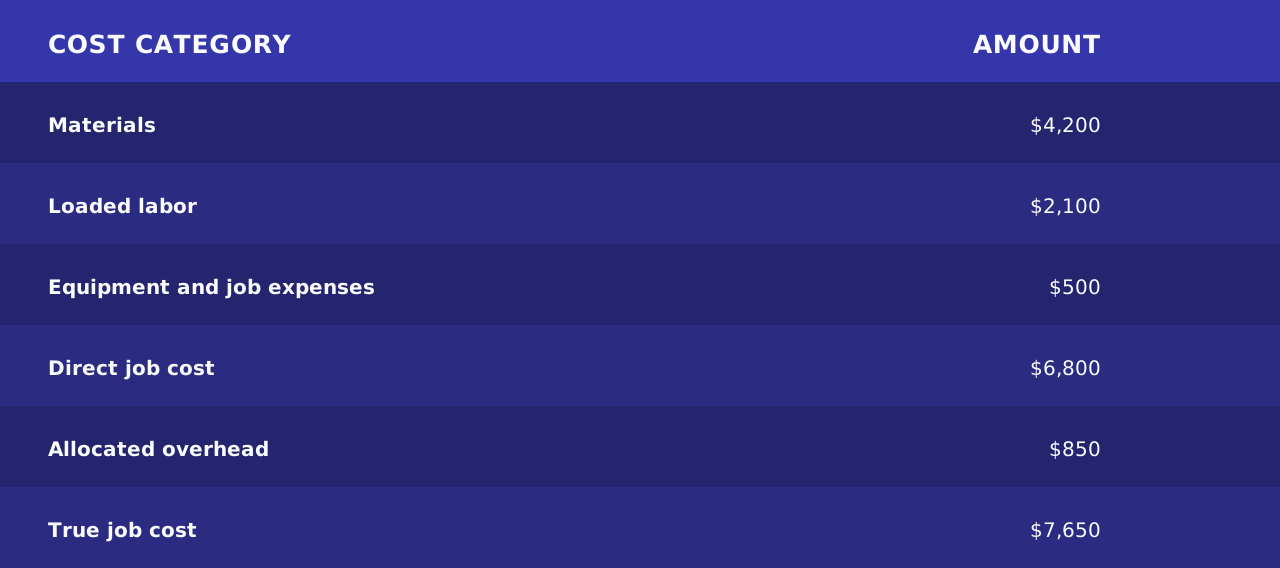
Chart data: direct job cost $6,800 + allocated overhead $850 = true job cost $7,650.
Choose one overhead method and use it consistently. You might apply overhead per billable labor hour, per crew day, as a percentage of direct cost or through a monthly recovery target. The method matters less than using real company numbers and checking whether sold jobs recover the total.
Do not call the money left after materials and wages profit when overhead has not been accounted for. That number is still paying for the business.
Add Contingency for Identified Risk
Contingency covers known uncertainty, not weak estimating. A rocky site, unclear demolition conditions, hand-carry access or a complex custom gate deserves more protection than a repeatable fence on open, level ground.
Write down why the allowance exists. If you cannot name the risk, go back and improve the scope. And if the customer changes the height, material, style, layout or gate after approval, issue a change order. Recalculate the cost, labor and price before the changed work begins.
Apply Gross Margin Correctly
Markup and margin are not interchangeable. If true job cost is $8,000 and you add 30%, the selling price becomes $10,400. The gross profit is $2,400, which is only 23.1% of the selling price.
To produce a 30% gross margin, divide the cost by 0.70:
$8,000 ÷ (1 − 0.30) = $11,428.57
That $1,028.57 difference is the cost of confusing markup with margin on one job. Your target margin should come from your overhead, capacity, risk and business goals. Then compare estimated and actual gross profit after each job. Your own completed work is the best source for improving the next estimate.
How to Calculate Fence Job Cost: A Worked Example
Assume a fence project has $2,750 in current materials, waste and delivery. The crew needs 40 person-hours at a loaded cost of $38 per hour. Equipment and job expenses add $350, overhead allocation adds $700 and identified risk adds a $250 contingency.
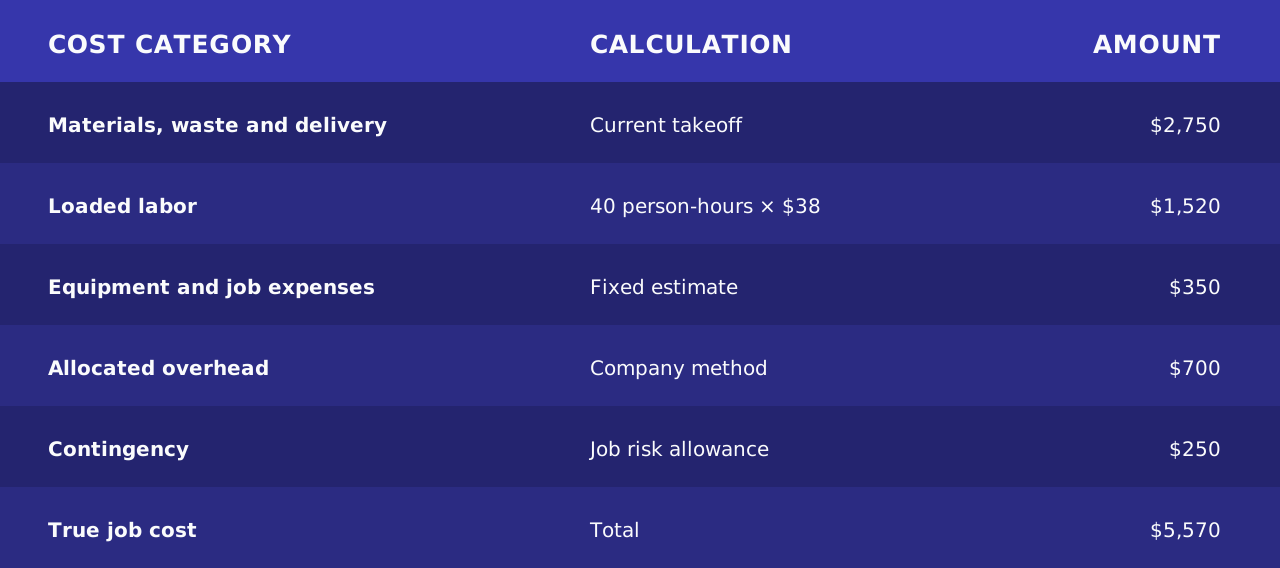
Chart data: materials, waste and delivery $2,750 + loaded labor (40 person-hours × $38) $1,520 + equipment and job expenses $350 + overhead $700 + contingency $250 = true job cost $5,570. At a 30% target gross margin, selling price = $5,570 ÷ 0.70 = $7,957.14.
The true job cost is $5,570. If the company targets a 30% gross margin, the selling price is:
$5,570 ÷ 0.70 = $7,957.14
Round only according to your quoting policy, then check the final price against local conditions and similar completed jobs. Do not lower it just because the number feels high. If the market will not support the required price, change the scope, production method or cost structure with clear eyes. Winning a job below its required price does not solve the problem.
If most of that price pressure comes from expensive shared leads, compare the required margin against the real cost of Angi, HomeAdvisor and Networx leads before you cut it. A steady flow of your own inquiries from fence company SEO makes it easier to hold the number your estimate says you need.
Should You Price a Fence by the Foot or by the Job?
Price the job first. Convert the completed selling price into a per-foot number second. This gives you a useful comparison without hiding the work that footage cannot explain.
Suppose two jobs are both 200 linear feet. One is a straight run on flat ground with truck access and no gates. The other includes old-fence removal, two gates, rocky soil, a slope and a hand carry through the backyard. A single price per foot treats them as the same job. Your crew will not.
Over time, your actual results can produce reliable starting ranges by fence type. Keep using a detailed estimate underneath them. The per-foot figure is a benchmark, not a substitute for the takeoff and production plan.
This is how to price a fence job without letting a familiar market rate hide the labor and conditions unique to that project.
Turn the Estimate Into a Clear Quote
The customer does not need to see every internal cost, but the quote should make the scope hard to misunderstand. State the fence type, height, approximate footage, gate details, demolition, finish, inclusions, exclusions, payment schedule, expected timing and how long the price remains valid.
Include a written change-order process. Customer-requested changes and newly discovered conditions should be priced and approved before work continues. A verbal we'll take care of it can turn a profitable estimate into a loss.
A clean quote also closes better when it reaches the customer fast. Getting it in front of them quickly is part of speed to lead for fence contractors.
Common Fence Estimating Mistakes
- Starting with a remembered price per foot and forcing the estimate to match it
- Using old material prices or leaving delivery and tax out
- Calling crew days labor hours instead of calculating person-hours
- Using wages instead of fully loaded labor cost
- Forgetting the final post, gate hardware, fasteners or concrete
- Ignoring access, slope, soil, demolition and disposal
- Treating overhead as profit or leaving it out entirely
- Adding a percentage markup when the target is a gross margin
- Absorbing scope changes instead of issuing a change order
- Failing to compare estimated and actual results after completion
Download the Free Fence Job Cost Calculator
A good fence estimate should make every cost visible before you commit to a price. Use the free fence job cost calculator to work through materials, loaded labor, job expenses, overhead, contingency and margin in the right order. Replace the guesses with your current numbers, then bid the job knowing what it needs to return. You can also find more practical advice in the Pax Pro fence contractor blog, including how to market a fence business.
Download NowWant to Know More?
Book A Call
Frequently Asked Questions
-
Charge enough to cover current materials, loaded labor, equipment and job expenses, allocated overhead, contingency and your target gross margin. Calculate true job cost first, then divide it by one minus your target margin. Local market prices can be a reasonableness check, but they should not replace your own cost calculation.
-
Estimate the person-hours required for layout, demolition, digging, setting posts, framing, installing panels or pickets, gates, cleanup and travel. Multiply total person-hours by the fully loaded hourly cost for each worker, including wages, payroll taxes, workers' compensation, benefits and other labor burden.
-
Build the estimate by the job because gates, corners, demolition, slope, soil and access can make two fences with the same length cost very different amounts. After calculating the complete selling price, divide it by the linear footage to create a per-foot comparison or quoting reference.
-
There is no single safe margin for every fence company. Your target must reflect your overhead, capacity, job risk, market and growth goals. Track estimated versus actual gross profit on completed jobs, then adjust your target and cost assumptions using your own results.
-
An estimate is an informed projection that may change when the scope or site conditions change. A quote is usually presented as a fixed price for a clearly defined scope and period. State what is included, what is excluded, how long pricing remains valid and how change orders will be approved.