 Phone: (021) 073-9955
 Location: New Zealand



How to Market a Fence Business: 9 Ways to Get More Leads
By Curtis Gray, Founder of Pax Pro. Published August 29, 2026. Updated September 8, 2026.
Most fence company owners can tell you exactly what a good month feels like. The phone rings before 8 a.m., the calendar fills three weeks out, every quote turns into a signed contract. They can also describe a bad month in just as much detail. What they usually can't tell you is why one turns into the other.
Key Takeaways
- Referral-only pipelines boom and bust. Spreading leads across local SEO, paid ads, offline signage, and follow-up is what steadies the calendar.
- Before you pay for new leads, work the quotes you already sent and never heard back on. It's the cheapest pipeline you already own.
- One client of ours, North Star Fence, booked 20 jobs worth roughly $110,000 from quoted-but-silent leads using a 3-text sequence sent over two weeks.
- Layer paid channels like Google Ads, Local Services Ads, Facebook, and geofencing only once your website reliably turns visitors into quote requests.
The short answer: market a fence business through a mix of local SEO, Google and social ads, offline tactics like yard signs and truck wraps, and the one thing almost nobody does, a structured follow-up sequence to the quotes you already sent and never heard back on. Referrals alone create a boom-bust cycle. The fix is spreading your pipeline across more than one source, then working the leads you already have before you pay for new ones.
The Marketing Mistake Most Fence Companies Make
Here's a pattern we see constantly. A fence company is fully booked one month and dead the next, and the owner assumes the fix is more advertising. More Facebook posts. A bigger yard sign order. Maybe a Google Ads account they don't really have time to manage.
That's usually not the real problem.
We had a client, North Star Fence, stuck in exactly that cycle. Busy one month, silent the next, running almost entirely on referrals. When we audited his pipeline, the issue wasn't a lack of leads. It was leads he'd already generated and quietly let go cold. Homeowners who'd gotten a final quote, never replied, and got mentally filed under "not interested." Nobody followed up. They just disappeared off the list, the way a name disappears off a whiteboard when nobody erases it, until eventually it's just gone.
That's the mistake, and it's a common one. Fence companies pour effort into a single channel, usually word of mouth, and treat every unanswered quote as a dead end instead of a lead that needs one more nudge. We'll come back to exactly what we did about it, because the numbers are worth waiting for. First, the full list of channels that actually work, and where the lead-revival piece fits into the bigger picture.
What You Need Before You Start Marketing
You don't need all nine of the tactics below running at once. You do need three things in place first, or you'll spend money finding leads with no real way to track or convert them.
- A Google Business Profile, claimed and filled out with your service area, hours, and real photos of finished fences. Not stock images. Homeowners can tell the difference, and so can Google. Our Google Business Profile checklist for fence companies covers every field worth filling in.
- A way to log every quote you send, including the ones that go quiet. A spreadsheet works fine to start. A CRM built for contractors works better, because it timestamps every touchpoint automatically instead of relying on someone remembering to update a cell.
- A clear service radius. Fence installation is local and physical work. Advertising to homeowners two counties over just wastes budget you could spend closer to home.
Skip any of these three and the tactics below get much harder to measure. You'll spend money and have no real way to tell which channel actually brought in the job versus which one just felt like it did.
9 Ways to Market a Fence Business
Here's how eight of the nine channels compare on how you pay, what they typically cost, and how fast they produce a first lead. Reviews and referrals (tactic eight) aren't in the table because they carry no media cost. Treat the dollar figures as illustrative planning ranges, not quotes. Real costs move with your market, the season, and how many competitors are bidding against you.
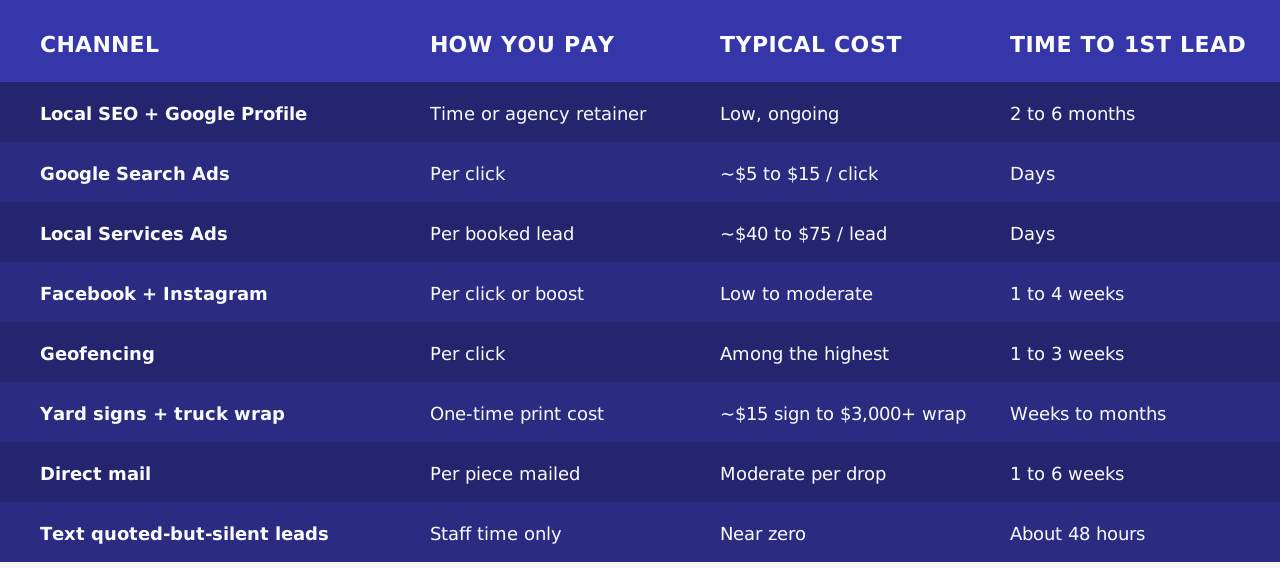
The same comparison in text:
- Local SEO and Google Business Profile: pay with time or an agency retainer, low ongoing cost, first leads in 2 to 6 months.
- Google Search Ads: pay per click, roughly $5 to $15 per click, first leads in days.
- Local Services Ads: pay per booked lead, roughly $40 to $75 per lead, first leads in days.
- Facebook and Instagram: pay per click or per boost, low to moderate cost, first leads in 1 to 4 weeks.
- Geofencing: pay per click, among the highest cost per click of any channel here, first leads in 1 to 3 weeks.
- Yard signs and truck wrap: one-time print cost from about $15 for a sign to $3,000 or more for a wrap, first leads in weeks to months.
- Direct mail: pay per piece mailed, moderate cost per drop, first leads in 1 to 6 weeks.
- Texting your quoted-but-silent leads: staff time only, near-zero cost, replies in about 48 hours.
1. Get found online with local SEO and your Google Business Profile
This is the slow-build channel. It won't fill your calendar next week, but it's the one that keeps working month after month without a fresh ad spend attached to it.
Start with your Google Business Profile. Optimize it with your exact service area, the fence types you install, and photos from real jobs, updated after every project rather than left untouched for a year. Then build a handful of service pages on your website, one for vinyl fence installation, one for wood privacy fences, one for chain-link, instead of a single generic "services" page trying to rank for everything at once and ranking for nothing in particular. We go deeper on the mechanics in our fence company SEO guide.
2. Run Google Ads and Local Services Ads
Google Ads puts you at the top of search results for people typing "fence company near me" right now. High intent, but you pay per click whether they hire you or not. Local Services Ads work differently: you pay per lead, Google runs a background check on your business, and you get the "Google Guaranteed" badge that homeowners actually recognize when they see it.
Cost ranges you'll see quoted for fencing sit around $5 to $15 per click for search ads and $40 to $75 per booked lead for Local Services Ads. Treat those as illustrative planning figures, not promises, because the definitions behind them are rarely stated. It still isn't cheap, which is exactly why tactic nine below matters so much. A lead you already paid to generate once is a lot cheaper to close a second time than a brand-new click is to close the first time. Google's own Local Services Ads overview is worth reading before setting a budget, since the pay-per-lead structure works differently from standard search ads. We cover setup step by step in our Google Ads for fence companies guide, and we break down third-party lead prices in our look at what Angi, HomeAdvisor, and Networx leads actually cost.
3. Market on social media, Facebook and Instagram specifically
Fence installs are visual work. Before-and-after photos, a drone shot of a finished privacy fence, a 30-second time-lapse of a crew setting posts on a Saturday morning. This content performs well because homeowners are shopping with their eyes long before they ever fill out a quote form.
On Facebook specifically: join local community groups, and don't just post ads in them. Answer questions when a neighbor asks for a fence recommendation. Run a boosted post targeted to your service radius using a real job photo, never a stock graphic. Pin your best review to the top of your page so it's the first thing a visitor sees. Facebook's targeting lets you narrow by radius and homeowner status in a way most other platforms don't offer as cleanly.
Instagram works best as a portfolio. Treat your grid like a gallery of finished jobs, not a feed of promotional graphics nobody asked for. Build a consistent posting cadence around completed projects, before-and-after photos, installation details, and customer outcomes.
4. Try geofencing for hyperlocal targeting
Geofencing is the one tactic almost nobody in this niche talks about, and it isn't cheap. Cost per click tends to run among the highest of any channel a fence company would touch, so get quotes before you commit. What you get for that price: ads that trigger specifically when someone's phone enters a defined radius, like a neighborhood where you just finished a job, or a competitor's active job site.
It's a fit for companies that already have their fundamentals covered and want an edge in one specific subdivision or new-build community. It is not a starting point. If you're just getting your advertising off the ground, skip this one until the cheaper channels below are already running and paying for themselves.
5. Put up yard signs while you're on the job, not just after
Cheap, physical, and it works because of something specific to fencing that most other trades don't get: a new fence is visible to every neighbor on the block, not just the homeowner who paid for it. It's the kind of visible upgrade neighbors notice and talk about over the back fence, and some of them will decide they want the same thing. A yard sign in the front lawn during the install, not just after the crew packs up, catches that window while the project is still fresh and the neighbors are still looking over the fence line wondering who did it.
6. Wrap your truck and hand out business cards that actually show your work
Your truck is a moving billboard you already own. A vehicle wrap costs a few thousand dollars once and keeps advertising every time you're parked at a job site, a hardware store, or a red light on a Tuesday afternoon. Pair it with business cards that show real work. A QR code linking to your photo gallery does more for a homeowner than a plain phone number ever will.
7. Send direct mail to your service area
Postcards and door hangers still work for home services, specifically because so few companies bother anymore. Everyone assumes direct mail is dead, so the mailbox that used to be crowded with fifteen competitors now has one. A simple postcard timed to spring, when most fence projects get planned, with a photo of a recent local job and a trackable phone number or promo code, lets you measure exactly what it brought in rather than guessing.
8. Ask for reviews, and understand why referrals alone aren't enough
Reviews and referrals matter. They're often the reason a homeowner picks up the phone in the first place instead of scrolling past your listing. The mistake isn't asking for them. It's stopping there. A referral-only pipeline depends entirely on how many fences you happened to finish recently and how happy those specific customers are. It has no floor under it. When referrals slow down, for any reason at all, your whole pipeline slows down right along with them. That's exactly the trap North Star Fence was in before we looked at his numbers.
9. Text your "lost" leads before you buy a single new one
This is the tactic that actually fixed North Star Fence's boom-bust cycle, and it costs close to nothing compared to any of the paid channels above.
Once we pulled his list of quoted-but-silent leads, we sent a 3-message text sequence spaced 3 days, 7 days, and 14 days apart. Not evenly spaced on purpose, so it didn't read as nagging. Anyone who replied got sent photos from his previous builds before we mentioned scheduling anything at all. Only once there was some back-and-forth did we book the on-site visit. If you want the timing, the scripts, and the tracking laid out step by step, we cover it in what to send when a customer goes quiet after a fence estimate.
Thirty-nine people replied within two months. That number alone surprised us. These weren't fresh leads; they were people who'd already gone quiet once. Twenty of the thirty-nine turned into signed jobs, a 51% close rate on leads everyone had already written off. At his average job value of $5,500, that works out to roughly $110,000 in revenue that had been sitting in his own CRM the entire time, just never followed up on.
Text outperformed email here for a specific reason: a quote that's already gone cold needs something that actually interrupts someone's day, and a fourth follow-up email in an inbox usually doesn't do that. A text does.
One thing worth being honest about. This isn't a tactic for a one-person crew. Twenty jobs landing on the calendar in a short window will bury a solo operator who's also the one swinging the post-hole digger. We'd recommend having at least three people on your crew before running a lead-revival push like this, otherwise you're just trading one kind of overwhelm for a different one.
Which Channel Should You Start With?
Not every channel deserves the same budget or the same month-one attention. Here's how we'd rank them for a fence business starting from scratch.
- 1. Text your quoted-but-silent leads. Near-zero cost, and it works pipeline you already paid for.
- 2. Claim and fill out your Google Business Profile, then build a service page for each fence type. Slow to start, but it compounds.
- 3. Add one paid channel: Local Services Ads if fencing is eligible in your area, otherwise Google Search Ads.
- 4. Put yard signs on every active job and wrap your truck. Cheap, physical, and local by default.
- 5. Post real project photos to Facebook and Instagram, and join local community groups.
- 6. Send seasonal direct mail to the streets where you've recently worked.
- 7. Test geofencing only once the channels above are running and paying for themselves.
The SBA's guidance on marketing and sales makes a similar point for small businesses in general: spreading a thin budget across every channel at once tends to perform worse than doing two or three channels properly. Start with the leads you already have, add one paid channel once that's dialed in, and build outward from there instead of launching everything in the same week.
Common Mistakes to Avoid
- Not tracking where leads actually come from. If you can't say whether a job came from Facebook, a yard sign, or a Google search, you can't tell what to spend more on next month. A simple "how did you hear about us" question on every quote fixes this for free.
- Running every channel at once from day one. New advertisers tend to launch Google Ads, Facebook ads, and direct mail in the same week, then can't tell which one is actually working when the phone finally rings. Add channels one at a time and give each one a fair month before judging it.
- Treating an unanswered quote as a no. This is the mistake that cost North Star Fence the most before we fixed it. A homeowner who didn't reply to a quote is not the same as a homeowner who said no. Most of them just got busy, or your quote got buried under three competitors' quotes in the same inbox. According to BrightLocal's Local Consumer Review Survey, the large majority of homeowners research more than one local business before deciding on any, which means silence is usually indecision, not rejection.
- Skipping the follow-up because it feels pushy. Three spaced-out texts over two weeks isn't pushy. It's the difference between a lead that converts and one that just quietly evaporates off your calendar.
- Budgeting for the ad but not the follow-up. A lead that doesn't get a same-day callback is a lead you basically paid to give to a faster competitor. Whatever channel brings the lead in, the speed of your response matters more than which channel it was.
Fence Marketing FAQ
How do I market a fence business online?
Start with a claimed, fully filled-out Google Business Profile and a handful of service-specific pages on your website, organized by fence type rather than one generic page. Add Google Ads or Local Services Ads once your site is actually converting visitors into quote requests. Running paid traffic to a weak website just wastes the click, so fix the website basics first.
How do I market a fence business on social media?
Post real project photos and short before-and-after videos rather than stock graphics or generic tips lifted from somewhere else. Facebook works best for community-group engagement and boosted local posts. Instagram works best as a visual portfolio homeowners browse before requesting a quote.
How do I market a fence business on Facebook specifically?
Join and genuinely participate in local community groups, run a boosted ad targeted to your service radius using a real job photo, and pin your best review to the top of your page. Skip the temptation to post only promotional content. Homeowners scroll past ads, but they stop for a photo of a fence that looks like the one in their own backyard.
How much should a fence business budget for marketing?
It depends on which channel you start with, but the honest answer is: less than you'd think, if you start with tactic nine. Reviving quoted leads costs almost nothing beyond the time to send three texts. Once that's dialed in, a reasonable next step is a few hundred dollars a month into either Local Services Ads or a Google Business Profile push before scaling into higher-cost channels like paid search or geofencing.
What to Do Next
If you only take one thing from this: before you spend a dollar on a new channel, pull your list of quotes that never got a reply and send three texts over two weeks. It's the closest thing to free money most fence companies have sitting in their own CRM, unopened.
Everything else here, SEO, Google Ads, Facebook ads, and geofencing, is what you layer on once that foundation is actually working. For more guidance on tying it all together, visit our fence marketing blog.
About the Author
Curtis Gray is the founder of Pax Pro, a marketing agency that works only with fence contractors. He and the Pax Pro team run local SEO, Google Ads, Local Services Ads, and lead-reactivation campaigns for fence companies across the United States, including the North Star Fence work described above. You can see client results on the Pax Pro reviews page or read more about how the team works on the about page.
Want to Know More?
Book A Call
Frequently Asked Questions
-
Yes. No contracts. Just give us 30 days notice so we can gather any leads we've generated for you and hand them over.
-
14 days. We send you an onboarding form, you give us your details, and we build your website. We also have an onboarding call to map out your current business structure so we can build your growth system around your business structure.
-
Yes, this is what most business owners do. You can upgrade your plan at anytime. No fees to switch.
-
No. We handle everything tech related for. We also provide personal training, videos and documents where it's needed.
-
We can build you a new website with location, service, and landing pages. We don't use templates or page builders.