 Phone: (021) 073-9955
 Location: New Zealand



Should Your Fence Company Use a Chatbot or Web Chat?
Curtis founded Pax Pro, a marketing agency that works only with fence contractors. He builds the websites, lead forms, and follow-up systems that turn quote requests into signed jobs, and writes about the sales side of running a profitable fence calendar.
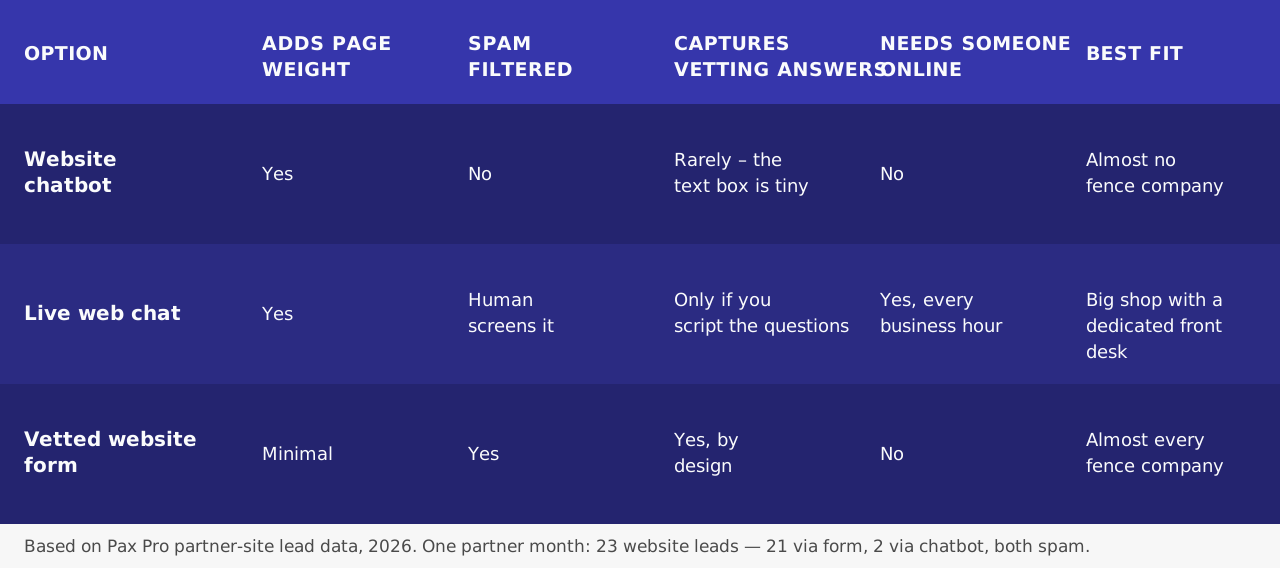
Short answer: for almost every fence company, use neither. A chatbot and a live web chat box both cost you more than they return. They slow the page down, they give a ready buyer somewhere to stall, and the messages that do come through are mostly junk. A website form with real vetting questions does the same job without the downsides. Here's the case, tool by tool, plus what to run instead.
Your website is one piece of a bigger picture. For how it fits the path from first click to signed job, see our fence lead-response system. This guide is about the contact box on the page and whether it should be a bot, a live chat, or something else.
Key Takeaways
- For almost every fence company, skip the chatbot and the live chat box. A vetted website form on every page does the same job without the downsides.
- Real numbers from one partner site: 23 website leads in a month, 2 through the chatbot, both spam. The other 21 came through the form.
- A chatbot's text box is small and has no spam filter, so you get vague one-liners and repeat junk. A form asks the questions you actually need answered.
- Chat widgets add page weight. A fast page wins more leads and better Google rankings than a widget that may never get used.
- Live web chat only works if a real person answers within a minute, every business hour. Most fence shops can't staff that, and an ignored chat box is worse than none.
Chatbot vs. web chat: what's the difference?
A chatbot replies on its own, with scripted or AI-written answers, and never needs a person online. Live web chat routes the visitor to a human, usually only during business hours. A hybrid runs the bot first, then hands off to a person or a booking link. On a lot of contractor sites, "web chat" is really chat-to-text: the conversation continues by SMS, which pulls in the same TCPA and 10DLC rules as a missed-call text-back setup.
Automation is common in the trade now. In Jobber's December 2025 survey of 1,050 US home-service owners, 52% said they already use AI in daily operations and 54% use it for quoting. That study is vendor-commissioned and covers home services broadly, not fencing. Common isn't the same as useful on your website, and that's the part the tool vendors skip.
What a fence buyer wants from your website
Three things, fast: a ballpark price, confirmation you cover their area, and a way to book an on-site visit. A homeowner pricing a fence is checking three or four contractors in one sitting. In Jobber's 2026 survey of 800 recent US homebuyers, 42% most wanted clear upfront pricing or a written estimate before hiring, 15% said they had to chase a pro for a reply, and 9% never got one. That survey covers home services broadly, not fence buyers, but the pattern holds.
Your site's job is to qualify the lead and book the visit, not to quote. A fence needs an on-site measure before you can price it. Being the contractor who answers first is often what wins the fence job, before either side has talked price.
Why we don't recommend a chatbot
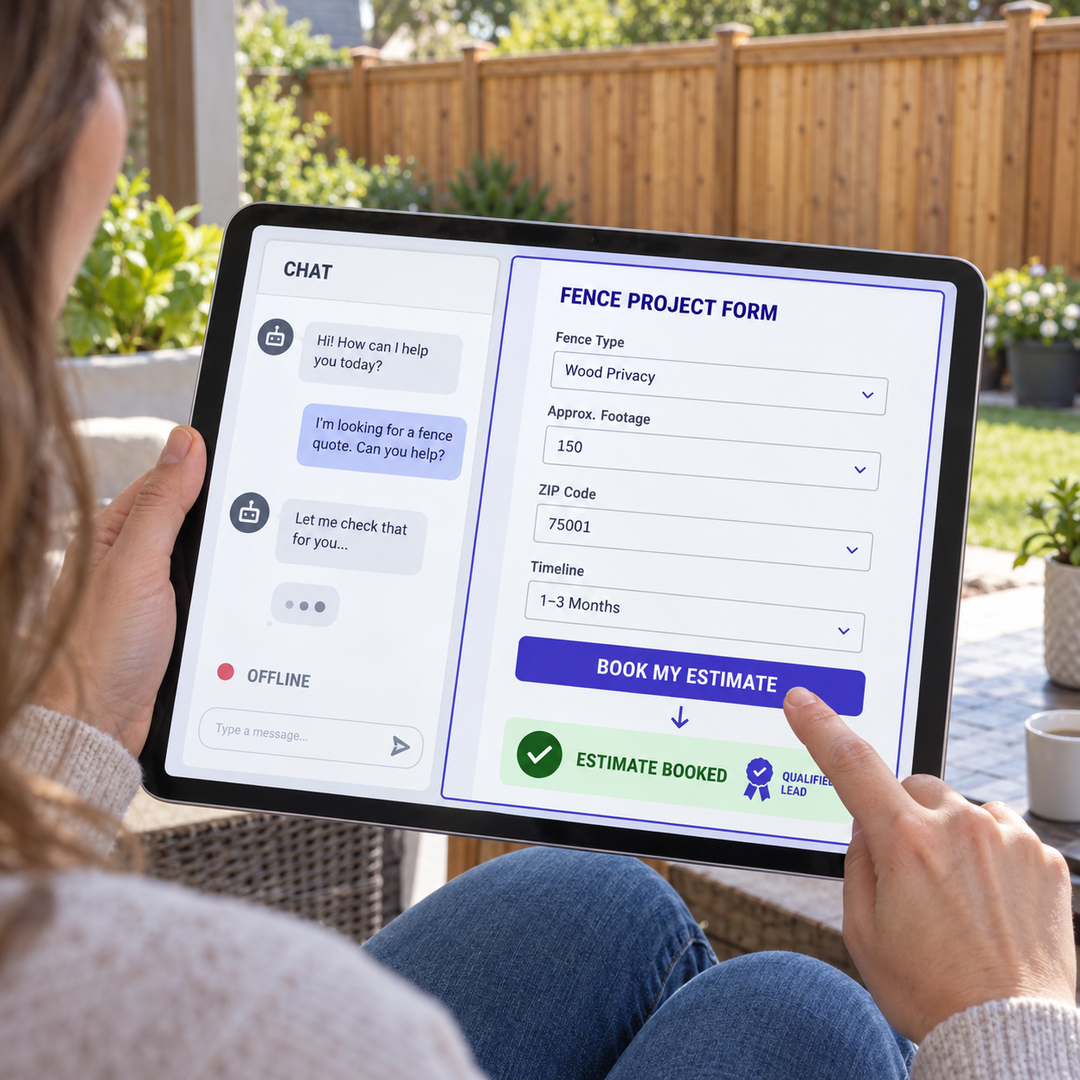
Across our partner sites, almost every real lead uses the website form, not the chatbot. The chatbot messages are spam or too vague to act on.
Take one partner as an example. In a single month their site brought in 23 leads. Two came through the website chatbot and both were spam; the other 21 came through the form. That pattern holds across the other sites too. The chatbot's text field is small, so people write one line and give up, and because nothing filters it, the same junk comes through again and again.
Our fence-company form asks the questions we actually need: fence type, rough footage, address, timeline, budget range. Those answers feed a system that scores each lead by priority and likely job value, so the best ones rise to the top of the week. A free-text chat box collects none of that structure, and it can't screen out what's obviously fake.
A chat widget is also real page weight for an uncertain payoff, and a fast page both converts and ranks better than a slow one. People also read the whole page, so by the time a visitor reaches the form at the bottom they don't need a chat box. In our data a chatbot books no more work than a form on every page does, which is why we just put the form on every page. As for the "chatbots lift conversion 30%" numbers you'll see, they come from the companies selling chatbots, with no independent study behind them.
Why live web chat is usually worse for a small shop
Live web chat only pays off if someone answers within a minute during business hours. An ignored chat box is worse than no box, because it makes a promise the page can't keep.
Most fence owners are on a job, up a ladder, or driving between sites. Nobody's watching a chat queue. FTC advertising guidance says claims have to be truthful and backed up, and a "chat with us now" box that sits unanswered is a broken claim. Plenty of buyers would rather reach a person than trade messages with a bot anyway, so a chat box that can't deliver one works against you.
Where live chat can fit: a bigger operation with a dedicated office person and steady commercial or HOA volume worth the staffing. Even then, test it against your form for 30 days before you keep it.
What each option costs
A standalone chat widget or bot runs roughly $20 to $100 a month. Bundled into a CRM or reputation suite such as Podium, Birdeye, or GoHighLevel, you're paying $300 to $500 a month for the whole platform, not just the chat feature. Staffed or managed live chat adds payroll hours or a retainer on top. Those are published vendor prices as of September 2026, so check the current pricing page before you buy.
The costs that don't show on the invoice matter more: a bad bot answer that annoys a buyer, a missed live chat, the time to write and maintain the flows, and the page-speed hit on every visitor whether they use the box or not.
What to use instead
Put a website form with vetting questions on every page, wired to a growth system that scores each lead by priority and likely job value from the answers.
Ask what you need to price and rank the job: fence type, linear footage, property address, timeline, budget range, whether they own or rent, and whether it's residential or commercial or HOA work. The form filters spam. The answers route the hot leads to the top and let you plan your week around job value. Our fence company website checklist covers where that form sits and what a fast, complete page looks like, and how to estimate a fence job covers where the job-value number comes from.
Pair the form with missed-call text-back so phone and web leads both get a reply within a minute, from the same system.
The one version of chat worth trying is a custom box that asks the exact same vetting questions as your form: same fields, same structure, same spam handling, just presented as a chat. We're testing that now and don't have results yet. A third-party bot with a free-text field isn't the same thing.
If you want the form and the lead scoring built to fit how your shop runs, book a growth call and we'll map it out.
Download NowHow to decide for your fence company
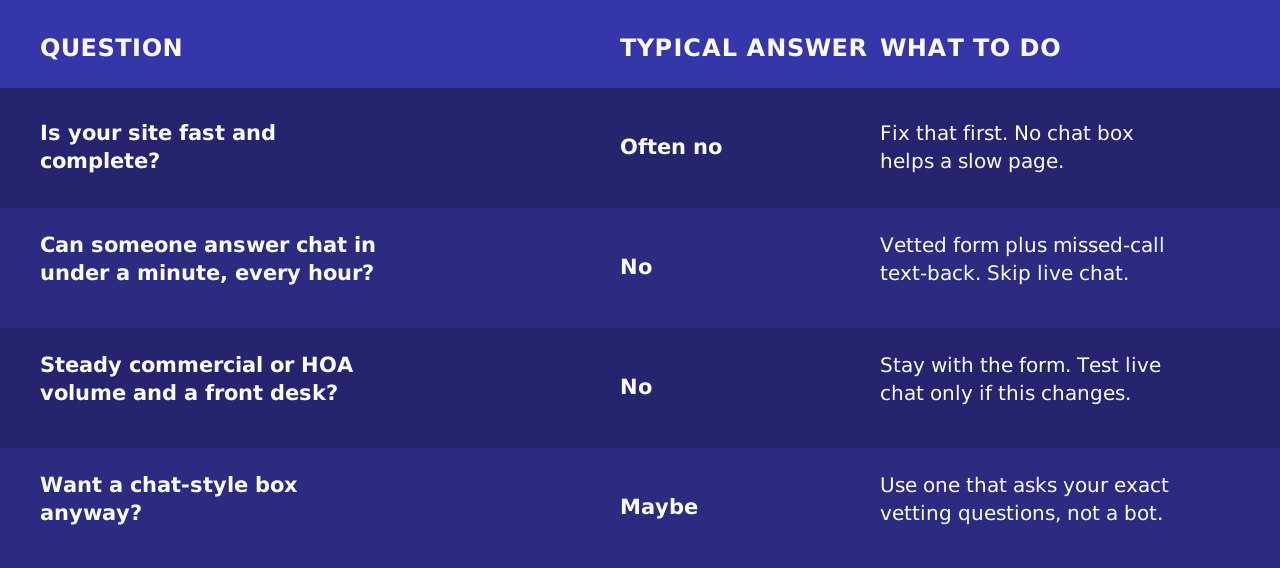
Three inputs settle it: who can answer during the day, your average job size, and how much of your traffic lands after hours.
- No daytime answerer: vetted form plus missed-call text-back. No chat box.
- Dedicated office person and big commercial or HOA tickets: you can test staffed live chat against your form for 30 days.
- Selling to visitors in California with a bot: the California B.O.T. Act says it has to disclose that it's a bot.
- Slow or thin site: fix that first. No chat tool helps a page that loads slowly or doesn't answer basic questions.
A 30-day test plan
Record your current form and call leads for a month. Add the tool. Then compare booked estimates and show rate, not "conversations." If the tool didn't put more real jobs on the calendar, take it off.
Put your effort where it pays
A chatbot and a live chat box both look like progress and mostly aren't, at least for a fence company. Spend the same effort on a fast page and a form that asks the right questions, wired to a system that tells you which leads to call first. That's what turns website traffic into booked estimates.
This fits inside the fence lead-response system, which maps every step from a new inquiry to a signed job. You'll find the rest of the sales-side playbook on the Pax Pro fence contractor blog, including fence estimate follow-up.
Download NowWant to Know More?
Book A Call
Frequently Asked Questions
-
For almost every fence company, neither. A chatbot adds page weight, has no spam filter, and collects vague one-liners because the text box is tiny. Live web chat only works if a real person answers within a minute during business hours, which most fence shops can't staff. A website form with vetting questions on every page does the same job without the downsides, and the answers let you score each lead by priority and likely job value.
-
Not in our data. On one partner site, 23 website leads came in over a month. Two of those went through the chatbot and both were spam. The other 21 came through the form. Across partner sites, almost every real lead uses the form, not the chatbot. Be skeptical of the "chatbots lift conversion" claims you'll see, because they come from the companies selling chatbots with no independent study behind them.
-
A standalone chat widget or bot runs roughly $20 to $100 a month depending on conversation volume and whether it does AI replies. Bundled into a CRM or reputation platform like Podium, Birdeye, or GoHighLevel, you're paying $300 to $500 a month for the whole suite. Staffed or managed live chat adds payroll hours or a retainer on top. Those are published vendor prices as of September 2026, so check the current pricing page before you buy.
-
It can give a rough price range and material information, but a real quote needs an on-site measure. Keep any chat tool focused on collecting the fence type, approximate footage, and property address, then book the visit. Asking a bot to produce firm pricing on a fence it can't see usually creates a number you have to walk back later.
-
Ask the questions you need to price and prioritize the job: fence type, rough linear footage, the property address, the timeline, a budget range, whether they own or rent, and whether it's residential or commercial or HOA work. Feed those answers into a system that scores each lead by priority and likely job value so the best leads rise to the top of your week.